The Challenge of Maintaining Curb Appeal in Any Season
29 October 2026
Curb appeal is the first conversation a house has with the world. Before a buyer steps inside, before an agent says a word, the exterior has already made an argument about what kind of home this is and how well it has been cared for. That argument is easy to win in late spring, when everything is green and the light is generous. It is much harder to win in February, when the lawn is dormant, the trees are bare, and the sky seems to be the same color as the driveway.
Most advice about curb appeal assumes fair weather. That is a mistake. A property is judged across all four seasons, and often the harshest judgment comes exactly when the exterior is hardest to manage. The homeowner who understands this stops chasing a perfect spring photograph and starts building a year-round impression. That shift in thinking is what this article is about.
Why Seasonal Curb Appeal Is a Different Problem Than Most People Think
The common misconception is that curb appeal is a maintenance task. Mow the lawn, trim the hedge, power-wash the siding, and you are done. In reality, curb appeal is a perception problem. What people notice is not the individual task but the overall signal of care, order, and intention. And that signal has to survive conditions that actively work against it.Think about what happens to perception in different weather. In summer, a single brown patch in a lawn reads as a minor flaw because everything around it is thriving. In winter, a single unshoveled walkway reads as neglect because it is the only thing a visitor can see clearly. The same small failure carries wildly different weight depending on the season. This is why a strategy built only for the growing season tends to collapse in the colder months.
There is also a practical reality: seasons compress your options. You cannot plant annuals in frozen ground. You cannot paint exterior trim in the rain. You cannot rely on lush growth to hide flaws when growth has stopped. The best exterior strategies are designed around constraints rather than ideal conditions, and constraints change month to month.
The Core Principle: Design for the Worst Month, Not the Best
If you take one idea from this article, make it this one. The strength of a property's curb appeal is set by its performance in its weakest season, not its strongest. A garden that looks spectacular in June but like a mud pit in March is not a high-curb-appeal property. It is a seasonal property with a long off-season.This principle has real design consequences. It means favoring structure over display. Evergreen bones, well-proportioned hardscape, clean lines, and consistent materials carry a property through the year. Flowers and foliage are the decoration; structure is the foundation. When the decoration disappears, the foundation is what remains, and it needs to be worth looking at.
It also means investing in the elements that never go dormant: the front door, the walkway, the porch, the roofline, the lighting, the house numbers, the mailbox, the condition of the siding and trim. These are the constants. A visitor's eye returns to them in every season, and their condition is read as a proxy for the whole house.
Winter: When Curb Appeal Is Won or Lost
Winter is the honest season. It strips away the softening effect of foliage and forces the exterior to stand on its own. It is also the season when most homeowners stop paying attention, which is precisely why a modest effort stands out.Snow and Ice Management as a Design Issue
Most people treat snow removal as a chore. It is better understood as a curb appeal decision. A cleanly shoveled walk, a cleared driveway, and a salted path communicate that someone is paying attention. An unshoveled one communicates the opposite, and it does so loudly, because snow makes every surface a blank canvas that highlights what has and has not been touched.There is a trade-off worth knowing. Aggressive salt use protects safety but can damage concrete, corrode metal, and harm nearby plantings. Sand and other abrasives offer traction without the chemical cost, though they track indoors and need sweeping. The right choice depends on your climate, your hardscape material, and how much foot traffic the entry receives. The point is to make a deliberate choice rather than defaulting to whatever bag is closest.
Evergreen Structure and Winter Interest
The plants that earn their place in a winter landscape are the ones with structure: evergreens with distinct shapes, trees with interesting bark, shrubs that hold their form under snow. A row of matching arborvitae, a well-pruned holly, a birch with pale bark, or a red-twig dogwood all provide visual interest when little else does. These are not decorative choices so much as architectural ones.This is also the season to notice proportion. Without foliage, you can see whether the plantings are the right scale for the house, whether the walkway is wide enough, whether the entry feels balanced. Winter is the best time to evaluate the bones of a landscape, and many designers deliberately review a property in January before proposing changes.
Lighting and the Early Dark
Short days mean that for several hours each evening, the exterior is seen primarily through artificial light. This makes lighting a first-order curb appeal tool rather than an afterthought. Warm path lights, a well-placed fixture highlighting the entry, and thoughtful illumination of a specimen tree can transform a winter facade. The common mistake is over-lighting: too many fixtures, too much brightness, and a result that looks commercial rather than welcoming. Restraint and warm color temperature usually serve better than volume.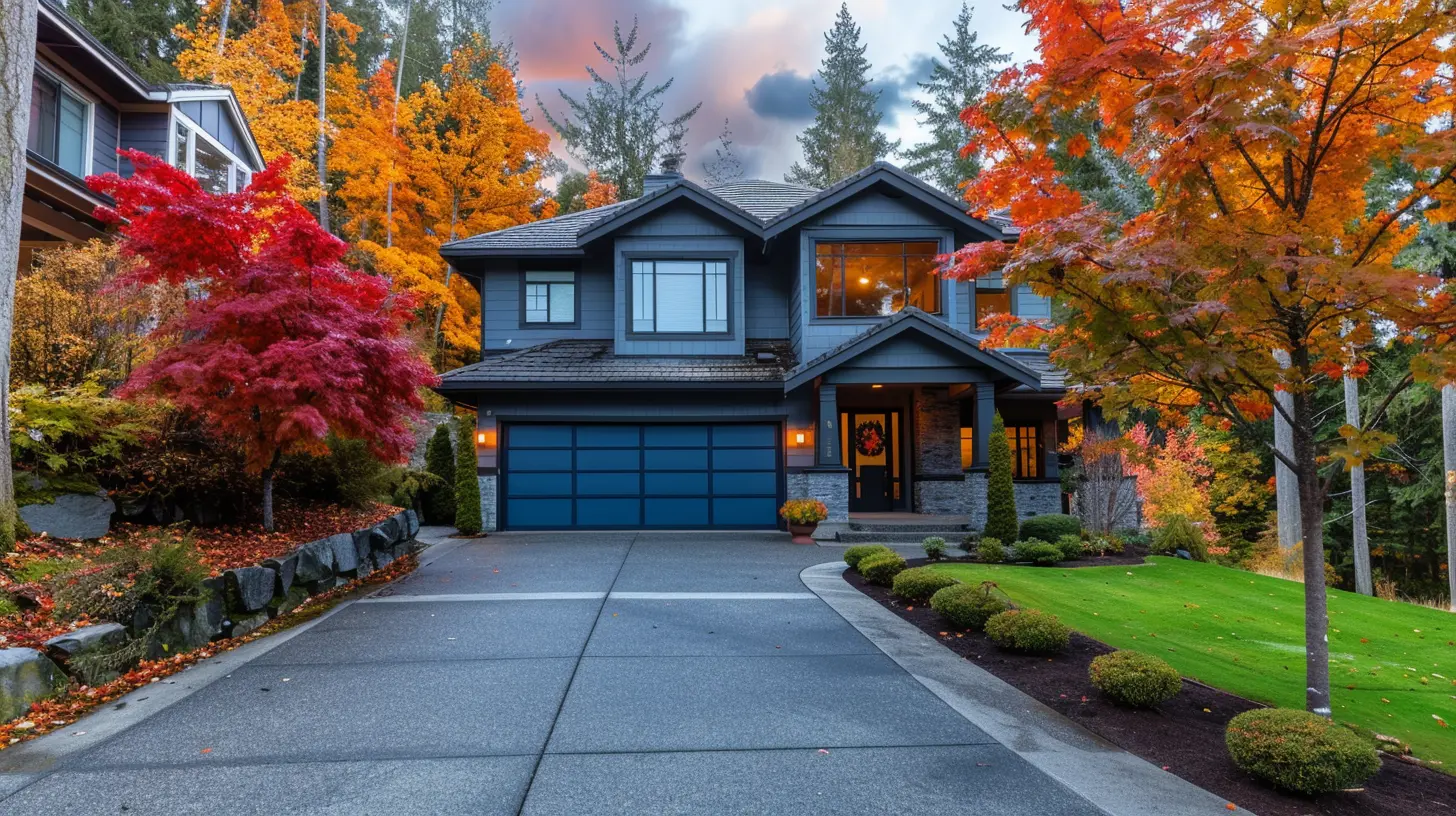
Spring: The Season of Expectations and Overreach
Spring is when curb appeal is easiest and when homeowners most often overdo it. The temptation is to compensate for winter with a burst of color, and the result is often a front yard that looks like a garden center exploded.The wiser approach is sequencing. Spring is the time to clean up winter damage, refresh mulch, edge beds, and address the hardscape before adding color. A clean bed with fresh edge and modest planting will outperform a crowded bed with no edge every time. Mulch deserves particular attention: too little looks neglected, too much piled against trunks can harm trees and shrubs. A consistent depth, kept away from stems, is the goal.
Spring is also when pruning decisions matter most. Pruning at the wrong time can remove the season's flowers or stimulate growth that a late frost will kill. The general rule is to prune flowering shrubs shortly after they bloom and to avoid heavy pruning of evergreens in favor of shaping. When in doubt, less is more, and a professional assessment before major cuts is usually worth the cost.
Summer: Maintenance Discipline and the Illusion of Ease
Summer looks easy because everything is growing. That is exactly the trap. Growth means maintenance, and maintenance done inconsistently is more visible in summer than at any other time. A lawn that is mowed at varying heights, a hedge that is trimmed unevenly, a bed that is weeded only when company comes: these read as carelessness precisely because the season sets a high bar.Watering is the central summer challenge. Lawns that are watered shallowly and frequently develop shallow roots and struggle in heat. Deep, infrequent watering encourages deeper roots and better drought tolerance. The trade-off is that deep watering takes more time per session and requires knowing your soil. Sandy soil drains quickly and needs shorter, more frequent cycles; clay holds water and needs longer, less frequent ones. There is no universal schedule, and anyone who offers one without asking about your soil is guessing.
Summer is also when the sun does its slow work on exterior finishes. Paint fades, wood dries and cracks, caulk shrinks. These are the signals that winter will later expose. A mid-summer walk around the house with a critical eye, noting peeling paint, loose trim, and failing caulk, prevents small repairs from becoming large ones before the cold sets in.
Autumn: The Transition Season Most Homeowners Mishandle
Fall is the season of preparation, and it is where disciplined homeowners separate themselves from the rest. The work done in autumn determines how the property looks in winter and how it recovers in spring.Leaf management is the visible task. Leaves left on lawns smother grass and hold moisture; leaves left in gutters cause water damage that shows up months later as stains and ice dams. Clearing them is unglamorous and decisive.
Planting is the strategic task. Autumn is generally an excellent time to plant trees and shrubs in many climates, because soil is still warm while air is cool, giving roots time to establish before dormancy. This is a case where the best time to improve next year's curb appeal is the season when this year's is fading. The caveat is timing and climate: planting too late in cold regions risks root damage before establishment, so local guidance matters.
Autumn is also the right moment to assess drainage. Fall rains reveal where water pools, where gutters overflow, and where the grade directs water toward the foundation. Fixing these issues before winter is far cheaper than repairing the consequences in spring.
The Constants: Elements That Carry Curb Appeal Year-Round
Across all seasons, certain elements do the heavy lifting. Understanding them helps prioritize spending.The Front Door and Entry
The entry is the focal point of almost every facade, and it is the one element a visitor is guaranteed to approach. A clean, well-painted door, quality hardware, a clear house number, and a defined path create a strong impression in any weather. This is one of the highest-return investments in curb appeal because it is visible in every season and every light condition.Hardscape and Walkways
Walkways, steps, and driveways are read as permanent, and permanence signals investment. Cracked steps or a heaved walkway undermine everything else, no matter how good the plantings are. Repairs here are not cosmetic; they are structural signals.Consistency of Materials and Palette
A facade that uses a restrained, consistent palette of materials and colors reads as intentional. A facade that mixes too many materials, colors, and styles reads as chaotic, and chaos is more noticeable in winter when there is less to distract the eye. Limiting the palette is one of the simplest ways to raise perceived quality.Maintenance as a Signal
There is no substitute for visible upkeep. Clean gutters, intact screens, straight shutters, and fresh caulk are small things that collectively say the property is cared for. Buyers and visitors do not itemize these; they absorb them as an overall impression. That impression is the entire point of curb appeal.
Common Mistakes and Misconceptions
Several recurring errors undermine seasonal curb appeal, and naming them helps avoid them.The first is treating curb appeal as a spring project. The property is judged year-round, and the off-season is when the judgment is most revealing.
The second is mistaking quantity for quality. More plants, more lights, more decorations do not equal better curb appeal. Restraint and coherence usually win.
The third is ignoring the view from the street at night. Many people assess their home only in daylight, yet evenings are when much of the neighborhood sees it. A quick evening walk to the curb reveals lighting problems immediately.
The fourth is deferring exterior maintenance until it becomes urgent. Paint, caulk, and gutters fail gradually and then suddenly. The gradual phase is when repairs are cheap.
The fifth is copying a neighbor's approach without considering differences in orientation, soil, climate microzone, and architecture. A strategy that works on a south-facing lot with sandy soil may fail on a north-facing lot with clay.
A Practical Seasonal Framework
A simple way to organize the year is to assign each season a primary job. Winter is about presentation: snow clearing, lighting, and visible order. Spring is about reset: cleanup, edging, mulch, and modest planting. Summer is about discipline: consistent mowing, deep watering, and spotting exterior wear. Autumn is about preparation: leaves, gutters, drainage, and planting for next year.This framework is not a rigid schedule. Climates vary enormously, and a property in a mild coastal region faces different constraints than one in a continental climate with hard freezes. The value is in the mindset: each season has a job, and the job is to protect the overall signal of care rather than to chase a single perfect moment.
When to Hire Help and When to Do It Yourself
Many seasonal tasks are manageable for a diligent homeowner: clearing leaves, shoveling walks, basic weeding, and consistent mowing. Others benefit from professional judgment: pruning that affects plant health and shape, drainage corrections, exterior painting, and lighting design. The decision usually comes down to risk. A mistake in weeding costs little. A mistake in pruning can cost a tree years of recovery, and a mistake in drainage can cost a foundation. Spending on expertise where mistakes are expensive is a rational allocation, and doing the low-risk, high-frequency tasks yourself keeps costs down.The Long View
Curb appeal is not a project with an end date. It is a discipline of paying attention across conditions that change constantly. The homeowners who do it well are not the ones with the biggest budgets or the most elaborate plantings. They are the ones who understand that a property is always communicating, and who make sure the message holds up in February as well as June.That is the real challenge of maintaining curb appeal in any season: not achieving a perfect look, but sustaining a credible one. Structure over decoration, consistency over novelty, preparation over reaction. Get those right, and the property will make its argument well, whatever the weather.
all images in this post were generated using AI tools
Category:
Real Estate ChallengesAuthor:

Basil Horne
Discussion
rate this article
1 comments
Zephyrwind Murphy
Great insights on curb appeal! Maintaining a home's exterior can be tough, especially with changing seasons. Your tips really help make it feel manageable and less overwhelming.
October 29, 2026 at 5:25 AM